

How much of your pitch needs drivable protection?
06/11/26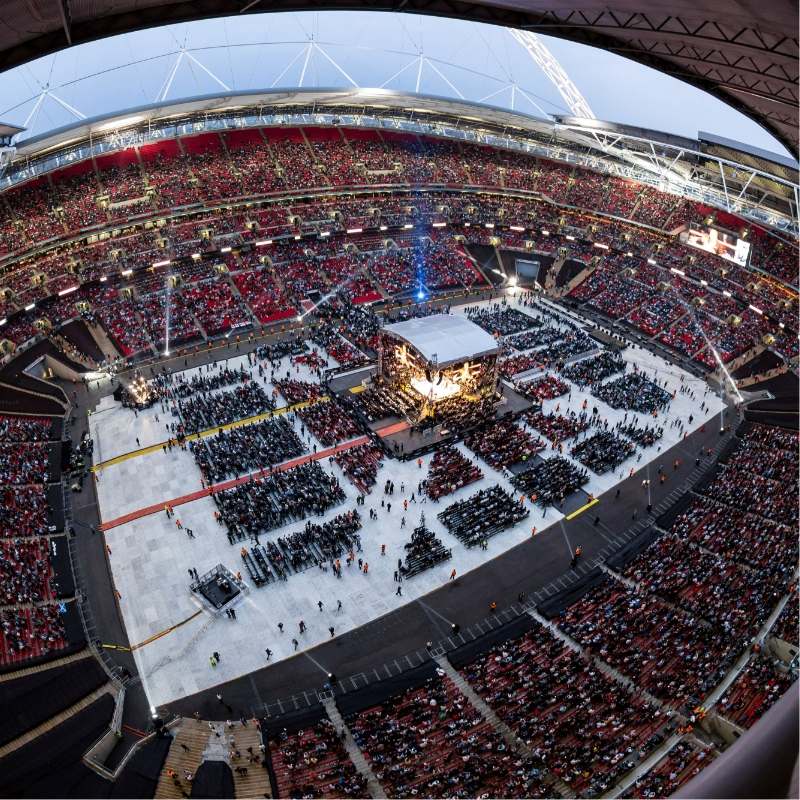
A concert plan tells you where the crowd will stand. It may tell you rather less about how the stage will get there.
Your crew still has to bring equipment onto the pitch, move it into position and take it all away again. Some of that work may cross areas marked for the audience.
That’s why choosing between pedestrian and drivable turf protection takes more than a look at the finished event layout. You need to know what will cross the pitch before the gates open and after the crowd goes home.
For some venues, a mix of the two makes the most sense. For others, the flexibility of a fully drivable floor is worth the extra investment.
Pedestrian flooring can do more than the name suggests
Pedestrian protection gives your audience a floor to stand on and protects the pitch from foot traffic. But “pedestrian” doesn’t necessarily mean that nothing with wheels can use it.
TerraTrak®, for example, can accommodate certain light vehicles with pneumatic tyres, such as gators and trolleys. The actual vehicle and what it’s carrying still need checking.
A loaded forklift is a different matter. Its hard tyres can put a lot of weight onto a very small patch of floor. That concentrated pressure can make it more demanding than a heavier vehicle that spreads its load over a larger area. So the biggest vehicle on the production list isn’t necessarily the one that decides the flooring requirement.
Heavy production traffic is where drivable protection such as TerraTrak® Plus comes in. It is designed to spread heavy loads and provide a working surface for vehicles.
It’s also worth keeping moving vehicles and stationary equipment separate in the discussion. A crane passing through and a crane working on outriggers place different demands on the floor. Approval for one doesn’t establish suitability for the other.
The case for mixing the two
If your production crew can keep heavy vehicles to agreed routes, you may not need heavy-duty flooring everywhere.
You can put drivable protection along those routes and around the working areas, then use pedestrian panels across the audience space. TerraTrak® and TerraTrak® Plus connect directly, so the two can form part of the same floor.
That gives you a way to control the cost without asking pedestrian flooring to do a job it wasn’t chosen for.
The route needs to include the whole journey, though. A strip from the tunnel to the stage is little help if a forklift has to leave it to turn or unload. Walk through those movements on the plan with the production team, including how they intend to take everything out afterwards.
If you’re buying for repeat use, think beyond the first concert. Will the next production put the stage somewhere else?
If layouts change frequently, covering the whole pitch with drivable protection may be worth the investment. It gives you more room to accommodate production routes without having to work around fixed pedestrian zones. You still need to check the actual loads and working positions, but you have more flexibility in planning them.
Your grounds team will want a say
While production is planning how to get the show in, the grounds team is thinking about what happens when it comes out.
They need to know how long the pitch will be covered, what condition it’s in beforehand and how much time they’ll have before the next fixture. Installation and removal count towards that cover period, even if the concert itself lasts only one evening.
On natural and hybrid pitches, light, ventilation, heat and moisture all matter while the grass is covered. The plan may be to retain the turf, or replacement may already be scheduled. Either way, protecting the rootzone and pitch structure remains important to getting the pitch ready again.
Bring the grounds team into the conversation while there’s still time to move a route or change the schedule. Artificial turf needs its own assessment too; a surface that doesn’t grow still needs protection appropriate to its construction.
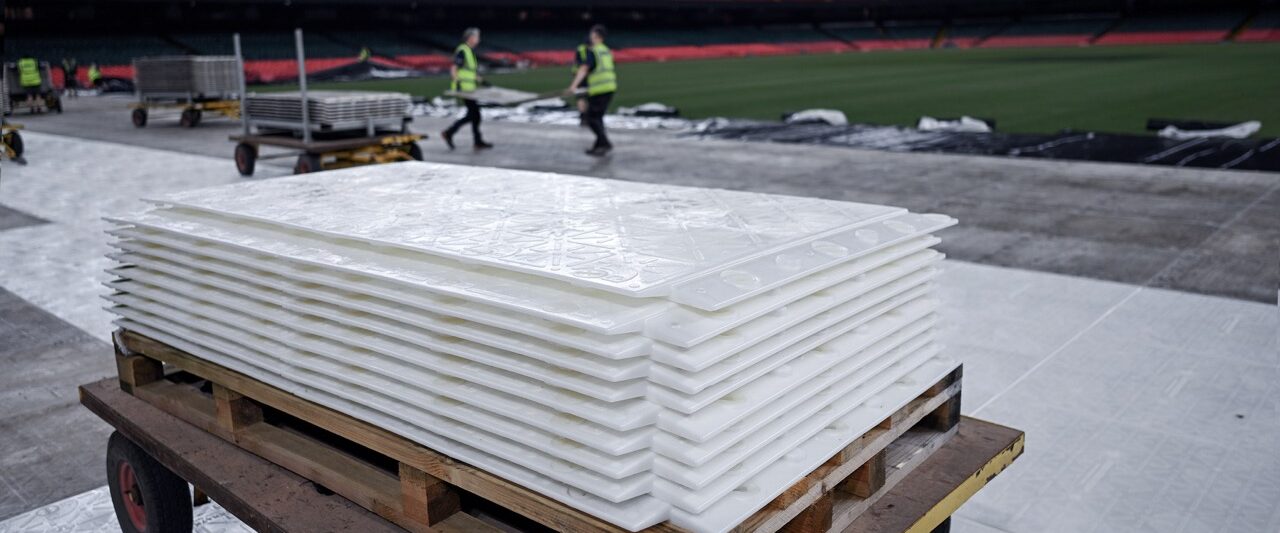
Before buying, think about the crew handling the floor as well. Where will it be stored? What equipment will you use to move it? Those answers matter when the same panels will be going down and coming up over successive events.
Send us the plan you have
You don’t need every production detail settled before speaking to us. A stadium drawing, a proposed event layout and an idea of the vehicles involved are enough to start a useful conversation.
Tell us your budget, when you need delivery and when the pitch needs to be back in sporting use. If you already own flooring, include the product details. A CAD or DWG drawing will help us work out the layout and tile quantities.
We can look at a mixed floor and full-pitch drivable protection with you, explain what each would mean for your venue, and identify any further information needed before recommending the products.
Call +44 (0)1332 812813 or send us an enquiry here.
Let’s start with what you want to do on the pitch and work out the floor from there.
MÁS NOTICIAS

The crowd hasn’t arrived. The stage is still going up. And a forklift is makin...

A primera vista, podría parecer que un sistema de protección de superficies ha cumplido su función: el...
Ya sea aprobando nuevos eventos, ampliando la programación de conciertos o aumentando las actividades no...