

Your pitch has a concert to get through. And a match to be ready for.
05/11/26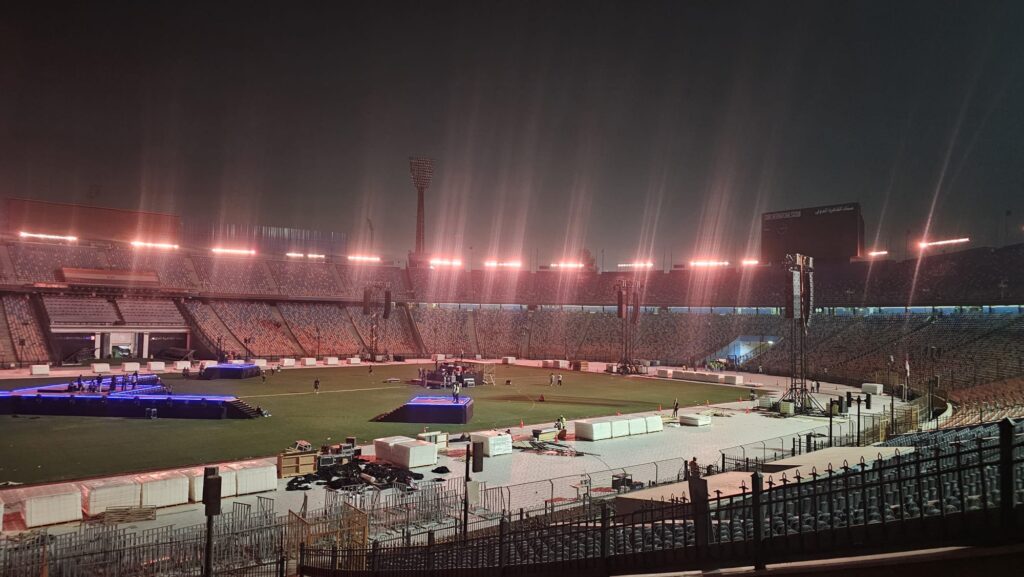
The crowd hasn’t arrived. The stage is still going up. And a forklift is making another trip across the pitch.
For the production crew, it’s one of hundreds of movements needed to get the show ready. For the grounds team, it’s another load passing over a surface they will soon need back in playing condition.
Both teams have a job to do. The protection plan has to work for both.
That starts with a question worth answering before any vehicle reaches the grass: what will this part of the pitch have to carry, from the first delivery to the last truck out?
Start with wheels, not just the weight
“We need to get a truck across the pitch.”
That tells a flooring supplier what you want to do. It doesn’t yet tell them enough to specify the protection.
How heavy will the truck be when loaded? How is that weight distributed across its axles? Where will it turn? Will it cross once, or use the same route throughout the build?
A forklift deserves particular attention. Its small, hard tyres can concentrate a heavy load onto a very small contact area, creating high pressure measured in pounds per square inch (PSI). That can make a loaded, hard-tyred forklift more demanding on the flooring than a much heavier vehicle whose load is spread over a larger area.
Even a crane’s greater weight does not settle the comparison: its tyres, tracks or outrigger pads determine how that load reaches the surface. Flooring suitable for a crane is therefore not automatically suitable for a forklift. Check the actual wheel loads and tyre contact areas before specifying protection.
Then there’s the movement itself. Repeated trips keep loading the same strip of pitch. Turning and braking introduce sideways forces as well as downward pressure. A busy unloading area can therefore need a different assessment from a straightforward access route.
Suitable drivable flooring spreads the load over a wider area. This helps reduce concentrated pressure on the pitch beneath while giving the crew a working surface above. The floor, ground conditions and planned movements all need to be assessed together.
The damage you see may only be part of the problem
Ruts and torn grass are easy to spot. Compaction beneath the surface is less obvious.
Heavy loading can compress the rootzone – the material in which the grass roots grow – affecting drainage and root development. So a pitch can need attention even where the grass still looks reasonable.
This matters whether you intend to retain the existing turf or replace it after the concert programme. The condition of the layers below it still affects the work needed to get the playing surface ready again.
Bring the grounds team into the discussion early. They know the pitch’s current condition, its weaker areas and what needs to happen before the next fixture. Their input belongs in the protection brief, while there is still time to change the layout.
Follow the whole journey across the pitch
Take the proposed event plan and trace a vehicle’s route from the entrance to where it will unload.
Now follow its way out.
Is there room to turn on the protected area? Does it have to cross what will become an audience zone? Where will it wait while another vehicle unloads?
These are the details a line drawn from the gate to the stage can miss. Mark turning spaces, unloading positions and working areas as well as the routes between them.
Check how each area will be used throughout the build. A space intended for standing spectators may first be needed by production vehicles. The flooring there must account for that earlier use too.
Stationary equipment needs its own assessment. A stage support or a crane working on outriggers puts load into the floor differently from a vehicle passing over it. Approval to drive through an area does not establish that equipment can operate there.
Once the layout is agreed, make it part of the contractor briefing. If a vehicle, working position or route changes, check the affected protection before the movement goes ahead.
Put the right protection where it is needed
A vehicle route and the audience area beside it have different jobs. Terraplas’s drivable and pedestrian systems allow the flooring to reflect that.
TerraTrak® Plus is the heavy-duty drivable system. Internal ribbing provides strength; its flat underside is designed to minimise compaction under heavy loading, and secured overlapping connections help resist twisting as vehicles move across it.
TerraTrak® belongs to the pedestrian range. Its published applications also include light vehicles with pneumatic tyres, such as gators and trolleys. That does not make it a substitute for TerraTrak® Plus on heavy production routes.
The two systems connect directly. This allows an assessed vehicle route to run alongside pedestrian flooring, with the product choice following the work each area must accommodate.
The clock keeps running after the encore
When the audience leaves, the production vehicles return. Protection must stay in place wherever they still need access.
Agree the removal sequence before the build starts: which areas can be uncovered first, which routes must remain, and when the grounds team can take each area back. Otherwise, the push to clear the pitch can conflict with the access needed to finish the job.
Count the full period under cover, too. Light, ventilation, moisture and temperature all affect the grass. The grounds team needs to consider those conditions alongside vehicle loading and the time available before sporting use resumes.
What that looks like in practice
At Cairo International Stadium, Terraplas worked with Dino Activations on a concert project covering more than 20,000 m² of natural grass with TerraTrak® Plus and TerraTile®.
The brief included heavy production equipment and staging, audience footfall, extreme summer heat and demanding installation and removal schedules.
Terraplas developed flooring layouts for different stage arrangements and event formats, then provided on-site installation supervision and training. The work brought product selection, layout and installation together around the venue’s needs—the same approach that should guide the next project, with its own loads and conditions.
Bring us the plan you have
You don’t need every production detail settled to start a conversation.
The following gives Terraplas a useful starting point:
- Your venue, pitch dimensions, surface type and current condition.
- A layout showing entrances, vehicle routes, turning and unloading areas, staging and audience zones.
- Vehicle details, available operating weights and axle loads, what they will carry and how often they will cross.
- Available load information and support positions for stationary staging and equipment.
- Build, concert and removal dates, expected cover periods and the next sporting-use date.
- The grounds team’s requirements, including planned turf replacement or reinstatement.
Send what you have and flag what is still to be confirmed. Terraplas can review the proposed pedestrian and drivable areas with you and identify what else is needed to assess suitable protection.
Call +44 (0)1332 812813 or speak to us here.
MEHR VON UNSEREN NEUESTEN NACHRICHTEN
A concert plan tells you where the crowd will stand. It may tell you rather less...

Auf den ersten Blick könnte man meinen, ein Oberflächenschutzsystem habe seine Aufgabe erfüllt: das...
Ob es darum geht, neue Veranstaltungen zu genehmigen, Konzertprogramme zu erweitern oder die nicht-ma...